
If you’re a landlord in Miami-Dade county, these are the exact steps to take when your tenant didn’t pay rent. This shows you how to fill out the 3-day Notice for Nonpayment of Rent, which is required before eviction. A Word template of the 3-day Notice is below.
(For other violations, such as rules violations, see instead what to do if your tenant violates rules of the lease.)
2 notes to consider before proceeding:
- You can legally proceed with the following steps as early as when rent is 1 day late. (Florida Statutes, 2025, § 83.56(3).[2])
- You can choose to wait as many days as you want before doing the following steps, but the longer you wait, the more you’re training the tenant that they can get away with paying later.
Step 1. Fill Out The 3-day Notice
As soon as the rent is one day overdue, you can fill out this 3-day notice for overdue rent. Your first step is to fill out the 3-day Notice required by Florida. The correct Notice to use for this case is called, “NOTICE FROM LANDLORD TO TENANT—TERMINATION FOR FAILURE TO PAY RENT.” Here is an example image of this 3-day notice for overdue pay rent:
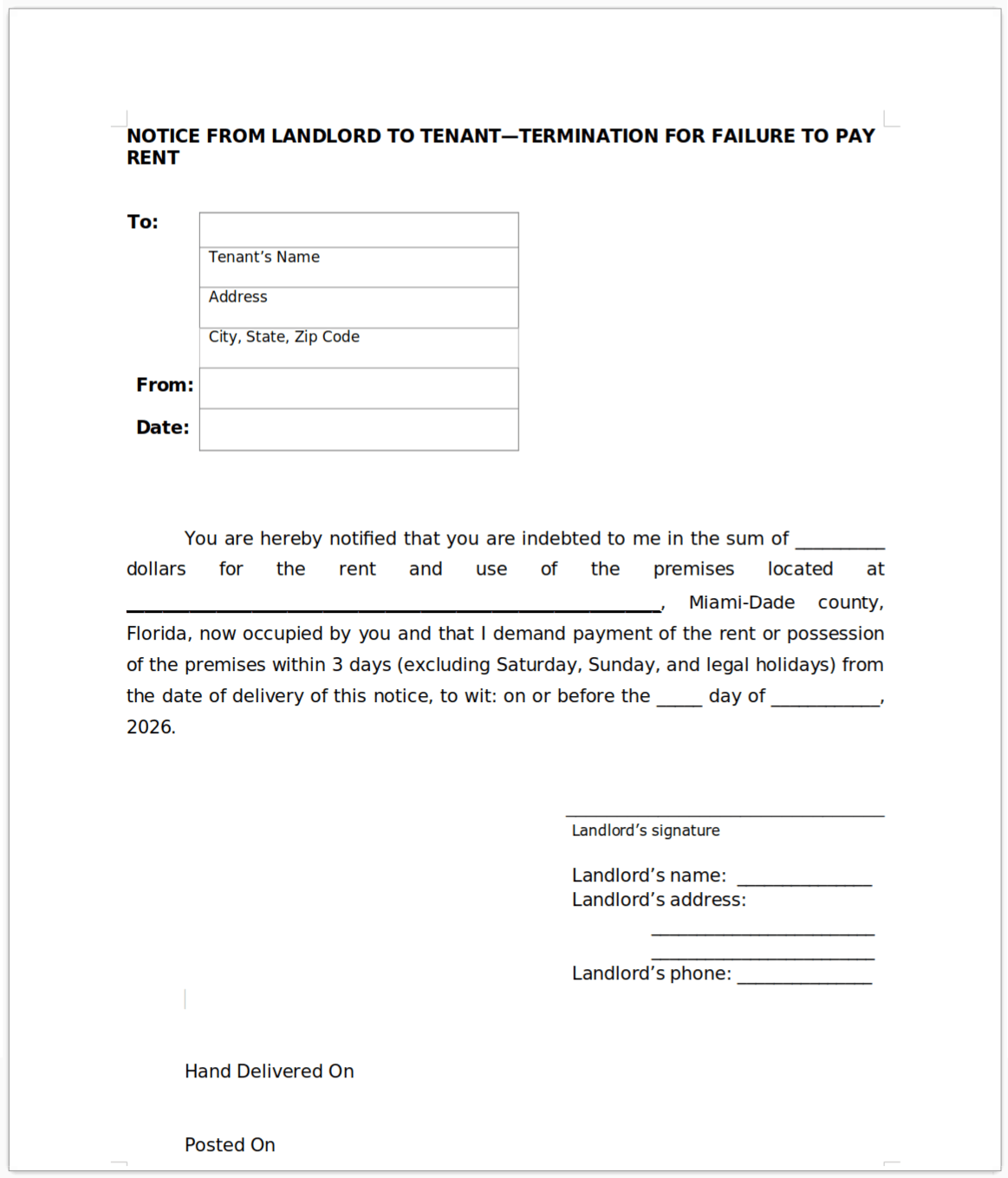
We offer an editable template of that Notice which you can edit in Microsoft Word, Google Docs, Apple Pages, and LibreOffice Writer. You can purchase the editable template of the Notice For Failure To Pay Rent here.
In our editable template for the 3-day notice, you only need to edit and enter the tenant’s name, the amount of money the tenant owes you, the address of the rental property, the deadline for them to pay, your name, address, and signature, and the date you are sending it.
Step 2. Calculate Deadline Date of the 3-day Notice
How do you figure out the exact date for the deadline date (the “on or before” date) to put on the Notice? To figure out the deadline date to put on the Notice, even though it says “3 days,” you need to add 5 additional days if you will send the Notice only by mail.[2] In any case, you need to calculate the deadline date like this: you don’t count the day that the tenant receives the Notice. Your count starts with the day after the tenant receives the notice if you deliver it in person. Your count starts with the day after you mail it if you send it by mail or email. And you never count weekends or legal holidays. So consider the way that you’ll be delivering the Notice:
- If you’re going to deliver the Notice in person or on the door of the rental property, start counting the 3 days on the next business day, and do not count weekends or legal holidays. (Florida Statutes, 2025, § 83.56(3).[2])
- If you’re going to send the Notice by mail only, instead of hand-delivery, you must add 5 more days (not counting weekends or legal holidays) in addition to the 3 days. So you must count 8 days to get the correct deadline date, not counting weekends or legal holidays. And don’t count the day you mail it. Start the count on the next business day. (Florida Rules of General Practice and Judicial Administration 2.514(b).[1])
NOTE: It’s extremely important to write the correct deadline date, because if you write the wrong date, even 1 day off, then you could waste hundreds of dollars in court if you later have to evict through court and the judge denies your case because the deadline date was wrong.
Step 3. Make a Copy of the 3-day Notice
Before you send out the completely filled out Notice, make a copy of it and put it in the tenant’s folder (this is a folder in your own records that you should keep for each tenant – either a digital folder on your computer or a physical folder in your file cabinet). This copy of the 3-day Notice will be needed if you later have to evict through court.
Step 4. Deliver the 3-day Notice
Deliver the Notice to the tenant, either by mail or in person. Or you can tape it to the door if they are not home. If you use mail, do Certified Mail so you have a receipt to show in court. If you go in person to the rental property to deliver the 3-day Notice, be careful of possible dangerous situations. As an alternative, instead of delivering by mail or in person, you can send this Notice by email to them, but only if the tenant has signed an agreement to receive email notices of time-sensitive rental issues. (Florida Statutes, 2025, § 83.56(4).[2])
Step 5. Wait Until The Deadline Date, 11:59 PM
If they have not paid the total amount on the Notice by the end of the deadline date, by 11:59 PM, then the lease is considered terminated. If they haven’t moved out by that day, you can evict via court order. (Florida Statutes, 2025, §§ 83.56(3), 83.59.[2])
But before doing a court eviction, consider all of your 4 options now that lease is terminated:
- Work out a payment plan.
- NOT recommended. It never works. And you’d be training the tenant that next time they can just “work something out” again.
- Ask the tenant to leave.
- This option rarely works, but it’s worth a try in case of that 1 person that wants to leave but is afraid to break the lease. By letting them know that you’re okay with them leaving, maybe they’ll take you up on the offer.
- Pay the tenant to leave. (“Cash for keys”).
- Paying them to leave may be a lot cheaper than eviction. Court eviction can cost thousands, plus delay for several months of unpaid rent, plus they may trash the place. Instead, offer them a few hundred bucks to walk away quickly, saving their record from an eviction. But do so on the condition that they leave quickly (within 1-2 days) and that the property be “move-in ready” for next tenant. Don’t hand over the cash until they’ve vacated, given you the keys, and signed a release saying they’ve moved out, and you’ve inspected the rental property to make sure it’s not trashed.
- Evict them.
- This can be expensive and lengthy. That’s why “cash for keys” is the recommended option. However, if you choose to proceed with the official eviction, prepare the eviction package for Miami-Dade county and file it in court. Pay attention to the following notes before you proceed to evict:
- If the tenant does pay the total amount on the Notice before the end of the deadline, you must accept payment, and then you cannot file in court to evict for this instance on nonpayment of rent. (Florida Statutes, 2025, § 83.56(3).[2])
- If the tenant pays the total amount after the deadline, but you have not yet filed to evict in court, and if you accept this late payment, then you cannot file in court to evict for this instance of late payment. (Florida Statutes, 2025, § 83.56(5)(a).[2])
- However, if they offer to pay only a partial amount of the total before the end of the deadline, you do not have to accept the partial payment. You can still go to court regardless of whether or not you accept the partial payment. But NOTE that if you accept the partial payment, then you must do all 3 of these according to section 83.56(5)(a) of the Florida Statutes:[2]
- You must give them a receipt showing how much they paid and the remaining balance due.
- You MUST DEPOSIT THAT AMOUNT WITH THE COURT REGISTRY when you file the official eviction.
- You must give the tenant a new 3-day Notice for the new amount due. That is, for the remaining balance. Follow the same steps starting from #1 at the beginning of this article. So you basically start all over again with the new amount.
- This can be expensive and lengthy. That’s why “cash for keys” is the recommended option. However, if you choose to proceed with the official eviction, prepare the eviction package for Miami-Dade county and file it in court. Pay attention to the following notes before you proceed to evict:
References
- Florida Rules of General Practice and Judicial Administration 2.514(b). (https://www-media.floridabar.org/uploads/2026/01/2026_07-JAN-Florida-Rules-of-General-Practice-and-Judicial-Administration-1-1-2026-2.pdf)
- Florida Statutes §§ 83.56(3), 83.56(4), 83.56(5)(a), 83.59 (2025). (https://www.leg.state.fl.us/Statutes/index.cfm?App_mode=Display_Statute&URL=0000-0099/0083/0083.html)


